A Game Night with the Tarot
In the beginning, tarot was a game. Like croquet. Or Hearts. Or Boggle.
It was something people played together for a bit of friendly competition, for entertainment and recreation during social hours.
But the leap from doing fun and games for the heck of it to doing fun and games for the sake of understanding destiny is really a pretty small one.
We may have drawn a fairly arbitrary line around what’s play and what’s spiritual, but that line is easily smudged. We humans blur it easily, and often.
Including out in the general world of today, where the great Zoltar fortune-telling machine still graces many amusement parks and indie shops worldwide. Viral WitchTok videos and Etsy witches helped drive the global spiritual wellness industry to a record $4.2 billion last year. (BILLION.) And Hasbro, the board game company, owns the Ouija board trademark.
We are not new to this, we are true to this. As a species, we have long liked the particular flavor of entertainment that comes with a side of the mysterious beyond.
That’s what I learned when I jumped into researching divination tools while working on a commissioned piece for The Curationist, “Tools for Foretelling the Future,” a curated collection created out of their online cultural archive. I quickly found myself in a divine treasure trove of not just very serious oracular instruments but also parlor games, whimsical books, and even a paper fan that reminds me a lot of an 18th century version of the folded paper fortune teller called the “cootie catcher.”
The below is a cootie catcher from 2006, for the nostalgia.
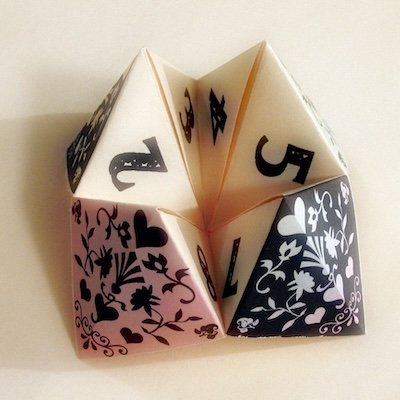
Cootie catcher fortune teller, 2006, Paul Blais, Wikimedia Commons. Public domain.
We had the cootie catcher and 18th century France had this paper fan.

Anonymous, Vouwwaaier met twee papieren bladen, waarop het vraag- en antwoordspel "l'Oracle" is gedrukt en ingekleurd, op een gesneden ivoren montuur voorzien van 'métal en quattre couleurs', c. 1780 - c. 1790, ca. 1780 - ca. 1790, Rijksmuseum. Public domain.
It’s kind that ladies would take to social calls and outings. The makers of this particular fan had printed fortune-telling symbols on the back of it so that, during long boring hours in polite society, ladies could hold it up and entertain themselves by telling each others’ futures.
They would ask who would they marry, how many children would they have, etc. and the symbols and descriptions printed on the fan would give them their answers.
I’ve played that game, too. We called it MASH.
Among these treasures, I also came across a Book of Palmistry, which was published as a promotional entertainment booklet by an 1800s American tobacco company.
And then, of course, there was the tarot.
The tarot, I thought I knew about. I draw a lot of inspiration from its historical melding of form and function when I play with chance and choice and games and archetypal traditions in my own work.
I didn’t realize that I didn’t know anything yet.
Here’s the card, from the Minchiate tarot game out of 16th century Florence that first caught my eye when I searched up “tarot” in The Curationist archive.
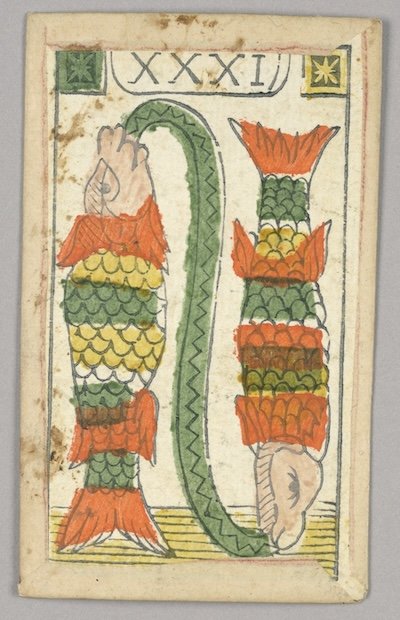
Minchiate (Tarot) Playing Card, 1600s, 1690s, “Cooper Hewitt, Smithsonian Design Museum”, Smithsonian Institution. CC0.
I immediately recognized this as a tarot card. The archetypal imagery and the large number indicating the order of this card in the deck gave it away for me.
But the Roman numerals on the card come out to number 31. And if you know modern tarot, you know that the major arcana cards - the cards outside of the four suits - only go as high as number 21, the archetype of The World.
What’s more, the illustration was immediately obvious to my zodiac-inclined mind as The Pisces, from the two fish swimming opposite directions, tied together with a cord. Even though certain zodiac signs are associated with each of the tarot’s major arcana cards, the cards do not typically include zodiac signs as the specific archetypes or face images on the cards.
So what was this card? What was I looking at?
Six hours later, I would finally crawl out of the tarot games rabbit hole it took me down.
I learned the rules of Minchiate (kinda, it’s a very complex game!). I learned about the message boards of people who play together to this day. I learned about the independent card printers still dedicated to preserving the original tarot games. And I learned that Minchiate, originating from Florence, Italy, had a whopping 96 cards where some of the numbered face cards would change based on popular public figures of the time. Also, that Minchiate had the twelve zodiac signs represented among its numbered cards.
Aha. And so I finally made it back to The Pisces, number 31 in the Minchiate tarot card game deck shown above.
And you know, tradition always tends to come full circle, doesn’t it. Sometimes when it does, it takes approximately 400 years and is utterly personal. Or at least that’s what happened for me as I took the twists and turns this research rabbit hole threw at me.
Because a few months beforehand, I had begun creating archetypal characters of the zodiac signs in my studio’s oracle story library. Which means that I already had my own version of The Pisces card, before I ever realized how much a part of the tarot’s tradition it really was.
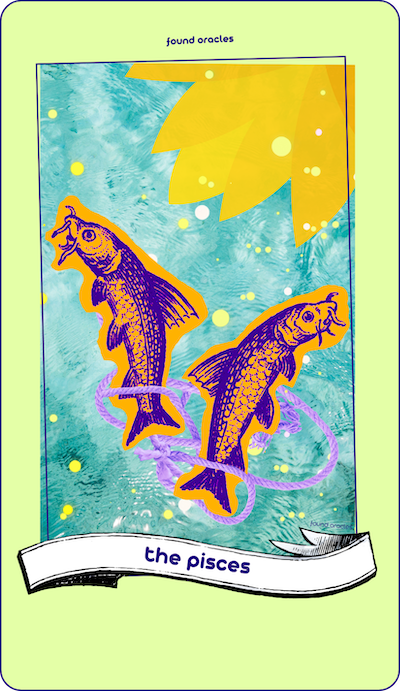
Found Oracles oracle character card, “The Pisces” 2026. Bailey Lewis, Bailey Sends Word Story Studio. All rights reserved.
Hilarious. I love it when this kind of thing happens.
I’m not the only one whose imagination and intuition was captured by the illustrated symbolism of these early tarot cards. A century or so after the debut of tarot games, people did one of my favorite things that people do: They turned this everyday object into a system for interpreting their own existence. It delighted and intrigued them. They found it fascinating and entertaining. So they fused it with their understanding of the world and created the symbolic system that we know today as the tarot.
And to this day, tarot maintains its whimsical roots. Tarot cards are read for entertainment at parties and events and venues. A huge number of tarot decks are still distributed by game publishers and entertainment companies. Tarot is for spiritual practice, yes. It’s for personal reflection, yes. And it’s also for fun.
For me, fun is always the part that invites people in to engage with something that brushes up the mysterious unknown. When fun is being had, guards come down. The mind and heart are more open. The self is less armored. When we are having fun, we are more open to being inspired, to unveiling new truths, and to new visions of what life and the world and the future can be.
The mystical, I have found, also loves whimsy, loves laughter, loves to play.
The moments where we’re enjoying ourselves are often the moments where the mystical shows its hand to let us know for 100% certain: It is alive and well in the seemingly mundane world.
So a game, to me, is always more than a game. The tarot is, historically, a great example of that.
Games are for entertainment, sure. They’re an amusement to pass the time, yes. An escape. But games also teach us things about ourselves. They help us see in different ways. They even allow us to try things we might not otherwise in a safe, low-risk space. They let us see what the outcome would be if we took the chance, did something new, engaged with the world in this way or that.
The same, I would say, is true of art. And of story.
★
I’ll link my version of the The Pisces from the free story library in my post picks below. You’ll also find the most popular oracle story from that free library as I’m writing this, along with a link to select your own oracular character and reveal the story meant to find you today.
This Post’s Story Picks:
Mystical lore for your email inbox
Get these posts sent straight to you as new ones are published, along with news and updates about the studio’s story releases, and the occasional oracle.
About Bailey Sends Word Story Studio
Bailey Sends Word is an independent, artist-led story studio headed by award-winning writer, interactive storyteller, and multimedia publisher Bailey Lewis. The studio is a place where the stories choose you and the mystical meets the everyday. You can learn more about the stories, Bailey’s work, and the studio by visiting baileysendsword.com.